Get pay-per-api 402 right
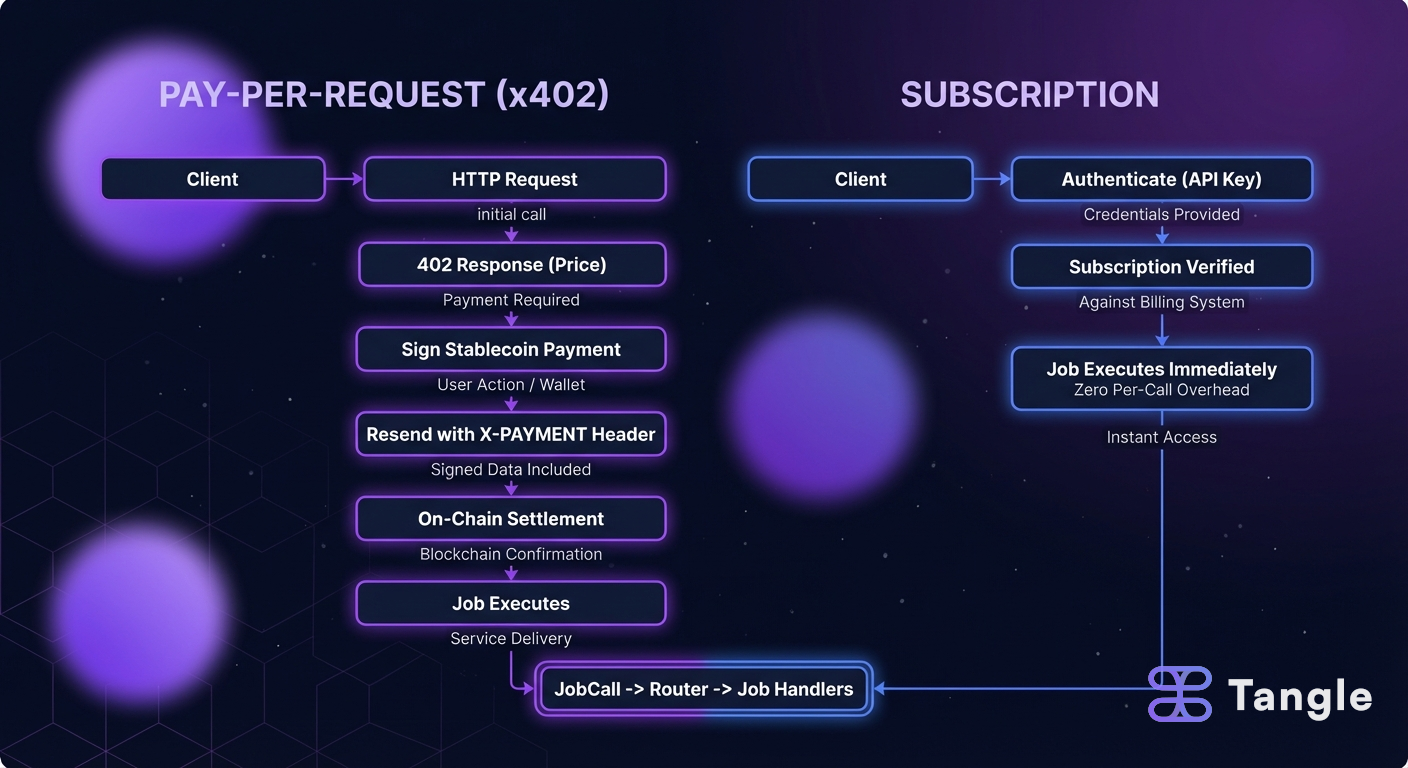
Before building your payment layer, you need to understand the protocol’s core mechanic: the 402 response is not just an error; it is a price quote. The x402 protocol embeds the current cost directly in the HTTP response headers. Your client sees the price before committing to a wallet transaction, ensuring transparency at every step.
1. Define your pricing unit
Decide whether you charge per call, per token, or per megabyte. Per-call pricing is the simplest model for basic APIs, where the total cost is the number of calls multiplied by a fixed rate. For AI agents, you might need more granular metrics. Ensure your pricing logic is deterministic so the 402 response always matches your internal ledger.
2. Implement the 402 response header
Your server must return a 402 Payment Required status code with a Payment-Policy header. This header contains the signed price quote, including the amount, currency, and payment URI. Do not rely on custom error codes. The standard 402 allows interoperable clients to recognize the payment requirement automatically.
3. Handle wallet integration
Clients need a wallet that supports the x402 protocol. The client reads the Payment-Policy, signs the transaction, and resends the request with the payment proof. If the payment fails or the price changes, the server returns a new 402 with an updated quote. This loop continues until the client pays or abandons the request.
4. Test with a mock client
Use a test client that logs the 402 responses. Verify that the price quote updates correctly when your pricing model changes. Check that the wallet integration handles edge cases, such as insufficient funds or expired quotes. This prevents production errors where clients get stuck in a payment loop.
Work through the steps
Pay-Per-API 402 works best as a clear sequence: define the constraint, compare the realistic options, test the tradeoff, and choose the path with the fewest hidden costs. That order keeps the advice usable instead of decorative. After each step, pause long enough to check whether the recommendation still fits the reader's actual situation. If it depends on perfect timing, unusual access, or a best-case budget, include a simpler fallback.

Common mistakes in pay-per-API 402 implementations
The HTTP 402 status code has sat dormant since the original 1997 web specifications, waiting for a reason to exist. Today, as infrastructure costs rise, developers are finally using it to gate API access. However, the transition from free endpoints to paid models is fraught with pitfalls. Implementing 402 errors incorrectly doesn’t just annoy users; it breaks agent workflows, confuses clients, and leaves money on the table.
The most critical errors stem from a lack of clarity and poor technical execution. Below are the specific mistakes that cause poor outcomes and how to avoid them.
Treating 402 like a generic 403
The biggest mistake is using 402 as a synonym for "unauthorized" (403) or "forbidden" (401). A 403 response tells a client that access is denied due to security or permission issues. A 402 response specifically means the resource exists, but a payment is required to unlock it.
If you return a 403 when the user simply hasn’t paid, automated agents will retry indefinitely or abort, assuming a security block. Always reserve 402 for payment walls. This distinction allows client-side code to differentiate between a security breach and a billing issue, enabling smoother recovery flows.
Omitting the price in the response
A 402 response is useless if it doesn’t tell the client how much to pay. The x402 protocol standardizes this by including the current price in the response headers. If you return a 402 without a clear price, the client cannot proceed.
Agents like those using the x402 protocol expect the price to be visible before payment. If the price is missing, the agent cannot make a decision. This leads to failed transactions and frustrated developers. Always include the exact cost in the HTTP headers so the client can compare it against its budget.
Failing to handle idempotent payments
API calls are often retried due to network instability. If your payment logic isn’t idempotent, a single API call might trigger multiple charges. This is a common source of customer complaints and refund requests.
Ensure that your payment gateway can handle duplicate requests. If a client sends the same payment token twice for the same resource, the system should recognize it and grant access without charging again. This requires tracking payment IDs against resource access logs. Without this check, your API becomes a source of billing errors rather than revenue.
Ignoring client-side caching
Many clients cache responses aggressively. If a 402 response is cached, subsequent requests might hit the cache instead of the server, leading to unexpected behavior or repeated payment prompts.
Configure your cache headers carefully. Use Cache-Control: no-store for 402 responses to ensure the client always checks for the latest price and payment status. This prevents stale data from interfering with the payment flow and ensures that clients always see the current state of their account.
Pay-per-api 402: what to check next
Before deploying a 402 payment layer, developers often hit the same operational walls. These answers address the most common objections regarding the status code’s definition, error handling, and implementation strategies.
No comments yet. Be the first to share your thoughts!